
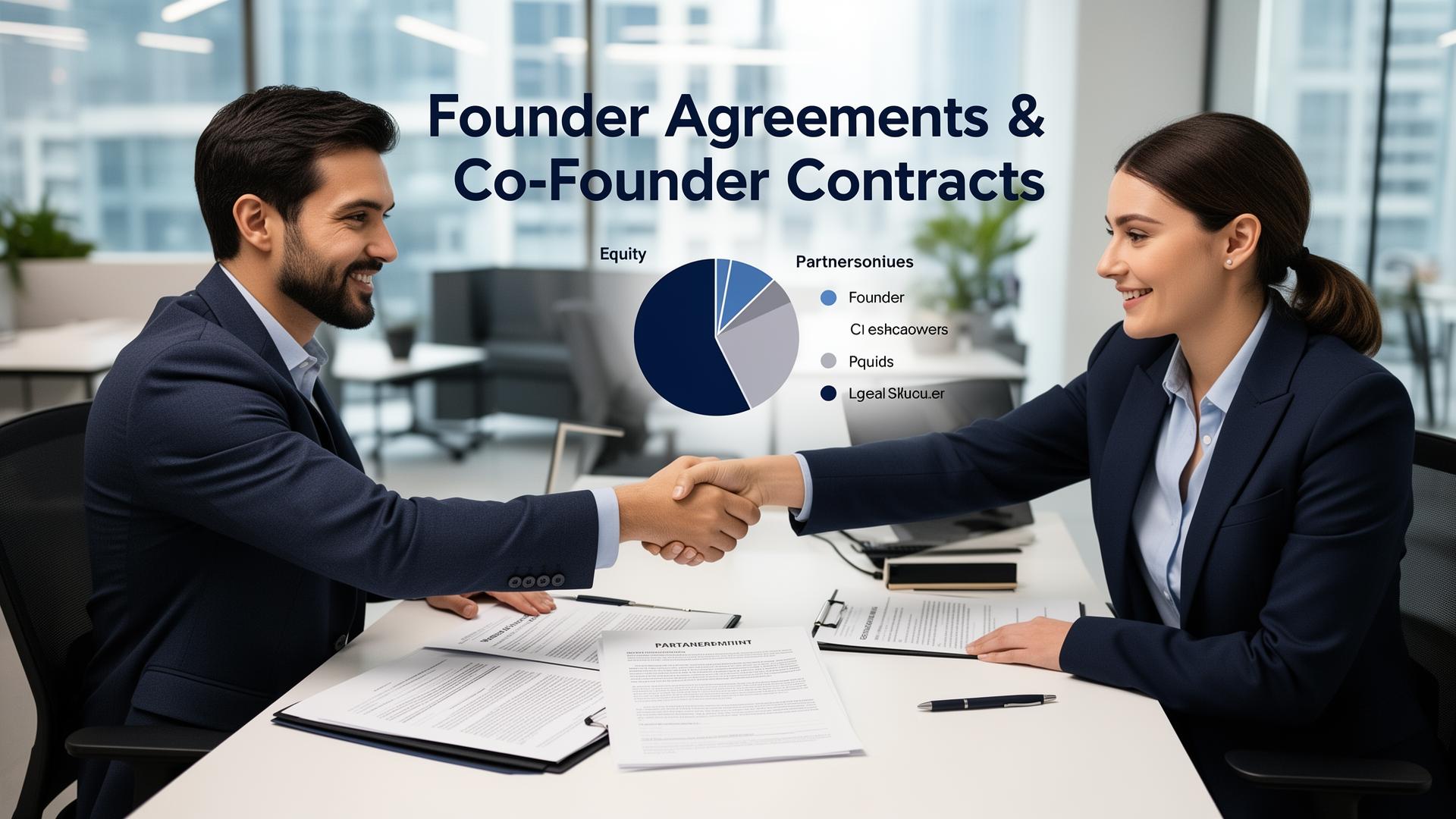
Founder Agreement Lawyer: Equity, Vesting & IP
By Andrew R. Jacobs, Esq. | Founder & Managing Attorney, Jacobs Counsel LLC | Director, Sports, Entertainment & Gaming Initiatives, Seton Hall University School of Law | Super Lawyers Rising Star 2026
Quick answer
A founder agreement typically documents equity, vesting, roles, decision rights, IP ownership, founder departures, and dispute mechanics before the company raises money or a founder leaves. There is no one-size-fits-all version: the agreement should fit the entity, cap table, governing law, and the founders' actual working relationship.
Key Takeaways
- Founder agreements help clarify expectations and reduce dispute risk—get one before you build
- Equity splits should reflect contributions, not just the initial idea
- Vesting aligns ownership with continued contribution—a four-year schedule with a one-year cliff is common, but not universal
- IP ownership should be documented—the agreement should clearly assign the work the company is intended to own
📋 Essential Founder Agreement Provisions
| Provision | What It Does | Why It Matters |
|---|---|---|
| Equity Split | Documents agreed ownership | Clarifies founder expectations |
| Vesting Schedule | Sets vesting and repurchase terms | Addresses continued contribution and departures |
| IP Assignment | Identifies the work assigned to the company | Documents the intended ownership chain |
| Roles & Decisions | Defines responsibilities and authority | Sets a process for decisions and deadlocks |
| Exit/Buyout | Addresses departure and equity treatment | Provides a framework for founder transitions |
The #1 Mistake
Splitting equity 50/50 without a vesting or repurchase framework. If one founder leaves early, the remaining team may be left with a large ownership stake held by someone no longer contributing. Vesting is common, but the schedule and repurchase terms should fit the company and the founders' arrangement.
A founder agreement typically documents equity, vesting, roles, decision rights, IP ownership, founder departures, and dispute mechanics before the company raises money or a founder leaves. There is no one-size-fits-all version: the agreement should fit the entity, cap table, governing law, and the founders' actual working relationship.
What is a Founder Agreement?
A founder agreement is a legal contract between co-founders that defines ownership, roles, responsibilities, decision-making authority, and what happens in various scenarios (departure, disagreement, acquisition, etc.). It's the foundational document that governs your relationship and protects everyone's interests. Think of it as a prenup for your business.
Why You Need One Before Launch
Many founders delay a written agreement because they expect to 'figure it out later' or trust the relationship to carry them through. The risk is not that every informal understanding is automatically unenforceable; it is that oral or incomplete arrangements can be hard to prove and may not satisfy applicable writing requirements. Investors and acquirers also commonly expect clean ownership, vesting, IP, and governance records. Documenting the arrangement while the founders are aligned is usually easier than trying to reconstruct it after a conflict.
Need a founder agreement built around your actual cap table and roles?
Key Components of a Founder Agreement
Equity Allocation: How is ownership divided among founders? Is it equal or weighted based on contribution, experience, or other factors? Equity splits should reflect each founder's expected contribution and value to the company. Clearly document the rationale so everyone understands and agrees.
Vesting Schedules
After agreeing on equity splits, founders commonly use vesting or repurchase rights so ownership reflects continued contribution. A four-year schedule with a one-year cliff is common, but it is not universal and should fit the company and the founders' arrangement. If a founder leaves early, properly drafted vesting and repurchase terms can keep unearned equity from remaining outstanding. Investors also commonly review these terms as part of the cap table and governance record.
Roles and Responsibilities
Define each founder's role, responsibilities, and decision-making authority: Who is CEO, CTO, COO, etc.? What are each founder's primary duties and areas of ownership? How are major decisions made (unanimous, majority, CEO authority)? What happens if a founder isn't meeting responsibilities? Clear roles prevent overlap, confusion, and conflict over who's responsible for what.
Time Commitment
Clarify expectations around time commitment: Is this full-time or part-time for each founder? What happens if someone wants to keep their day job initially? Are there minimum hour requirements? Mismatched time commitments destroy startups. If one founder is full-time and another is part-time, address how that affects equity, decision-making, and expectations.
Intellectual Property Assignment
The company should receive a clear assignment of the intellectual property it is intended to own. The agreement should address IP created before and during the company's existence, identify any prior-employer or third-party obligations, and define which work product transfers to the company. Ambiguous ownership can complicate fundraising, licensing, or an acquisition.
📥 Free Download: Deal Review Checklist
Understand the clauses that control payment, ownership, risk and your way out of a deal.
Download Free GuideCompensation and Expenses
How will founders be compensated? Are you taking salaries or deferring compensation? How are business expenses handled? Who can make purchases and within what limits? Document compensation expectations to avoid resentment when one founder draws a salary while others don't.
Decision-Making and Governance
How will major decisions be made? Define voting rights and decision-making processes: What requires unanimous founder approval? What can be decided by majority vote? What authority does the CEO have independently? How are tie-breaking situations resolved? Clear governance structures prevent deadlock and conflict.
Departure and Termination
What happens if a founder wants to leave or needs to be removed? Address: Voluntary departure process and equity treatment. Involuntary termination for cause (and how 'cause' is defined). Buyback rights for unvested equity. Non-compete and non-solicitation obligations post-departure. Having these terms in place before conflict arises makes difficult transitions smoother.
Dispute Resolution
How will you handle disagreements that can't be resolved internally? Options include: Mediation requirements before litigation. Binding arbitration clauses. Designated advisors or board members to help resolve disputes. A defined dispute-resolution process can reduce uncertainty, cost, and disruption if a disagreement cannot be resolved internally.
Confidentiality and Restrictive Covenants
Protect the company with appropriately tailored confidentiality obligations and, where lawful and useful, non-solicitation or other restrictive covenants. The enforceability of non-compete and non-solicitation provisions varies materially by state, the relationship, the scope of the restriction, and current law. Counsel should evaluate whether a restriction is permitted and narrowly tailored rather than treating it as boilerplate.
Founder Shares and Capitalization
Document the initial equity structure: How many shares does each founder receive? What type of shares (common, preferred)? What's the total number of authorized shares? How much equity is reserved for employee stock option pool? Having this clearly documented is essential for future fundraising and equity grants.
Amendment and Modification
Include provisions for how the agreement can be amended: Typically requires unanimous founder consent. Should be in writing and signed by all parties. May need board or shareholder approval depending on corporate structure. Flexibility to modify the agreement as the company evolves is important.
Common Mistakes to Avoid
Delaying the agreement until after launch or fundraising. Assuming 'we'll figure it out' is an acceptable approach. Creating overly simple agreements that don't address key scenarios. Copying templates without customizing for your specific situation. Not having legal counsel review the agreement. Failing to implement vesting schedules. Avoid these mistakes. A strong founder agreement is an investment in your company's future.
When to Create Your Founder Agreement
Ideally, before you incorporate. At the latest, before you start building the product, raising money, or hiring employees. The earlier, the better. Don't wait until you're facing problems to address them.
Working with Legal Counsel
While templates are a starting point, work with an experienced startup attorney to: Customize the agreement to your specific situation and state laws. Ensure all necessary provisions are included. Avoid unenforceable or problematic terms. Align the founder agreement with your corporate structure and other legal documents. Early legal review can be less disruptive than trying to unwind inconsistent ownership, IP, or governance expectations after a dispute.
Schedule a consultation to discuss a founder agreement tailored to your entity, cap table, governing law, and working relationship. Learn more about our business transactions practice.
📊 Founder Agreement Essentials
| Provision | Purpose | Terms to Tailor |
|---|---|---|
| Equity Split | Ownership allocation | Contributions, roles and agreed percentages |
| Vesting Schedule | Continued-contribution framework | Schedule, cliff, departure and repurchase terms |
| IP Assignment | Scope of company-owned work | Assigned work, prior obligations and exclusions |
| Roles & Decisions | Governance structure | Authority, voting thresholds and deadlock process |
| Exit Provisions | Departure scenarios | Equity treatment, buyback rights and approvals |
🚩 Founder Agreement Red Flags
- • No vesting (founder leaves with full equity)
- • Unclear IP assignment language
- • Missing decision-making framework
- • No provisions for founder departure
- • Handshake deals without written terms
Legal Disclaimer: This article is for general informational purposes only and does not constitute legal advice. Reading this article does not create an attorney-client relationship. Laws vary by jurisdiction and may change over time. You should consult counsel about your specific facts before making legal or business decisions.

About the Author
Andrew R. Jacobs, Esq.Founder & Managing Attorney at Jacobs Counsel LLC. Director of Sports, Entertainment & Gaming Initiatives at Seton Hall Law. Super Lawyers Rising Star 2026. Licensed in NY, NJ & OH.
Read full bio →Related on Outside Counsel for AI Startups & SaaS
Cornerstone guides and services
Fractional GC for AI Startups
How embedded, ongoing outside counsel works for AI-native and high-growth startups.
Read: Fractional GC for AI StartupsSubscription Legal Service for AI Startups
A buyer's guide to evaluating subscription-style legal arrangements — not an offer of named tiers.
Read: Subscription Legal Service for AI StartupsOutside Counsel Services
Ongoing outside counsel billed hourly, on a monthly retainer, or hybrid — with fixed fees for defined projects.
Read: Outside Counsel ServicesFound this helpful?
Deal Review Checklist
Understand the clauses that control payment, ownership, risk and your way out of a deal.
Related Articles
Equity vs. Salary: Legal Implications for Early Employees
Joining an early-stage startup often means choosing between higher salary and…
NIL & Athlete DealsWhat Changed for NIL Deals and Collectives in 2026?
A practical look at the 2026 NIL landscape: the House settlement, the Protect…
Gaming & ComplianceWhat the 2026 PA Skill Games Ruling Means for Operators
Pennsylvania's Supreme Court held skill games are illegal slot machines, with…
Keep Learning
More insights on Business Transactions legal strategies
Deal Review Checklist
Understand the clauses that control payment, ownership, risk and your way out of a deal.
Equity vs. Salary: Legal Implications for Early Employees
Joining an early-stage startup often means choosing between higher salary and more equity.
Startup Equity 101: Understanding Founder Shares, Vesting, and Dilution
For any startup founder, equity is the currency of creation. It's the fuel that attracts co-founders, incentivizes early employees, and secures investment…
Enjoyed this article?
Get weekly legal insights delivered straight to your inbox. We keep it brief and useful.
Need Legal Support?
We help high-performing creators, athletes, and founders protect their brands and build sustainable businesses.